

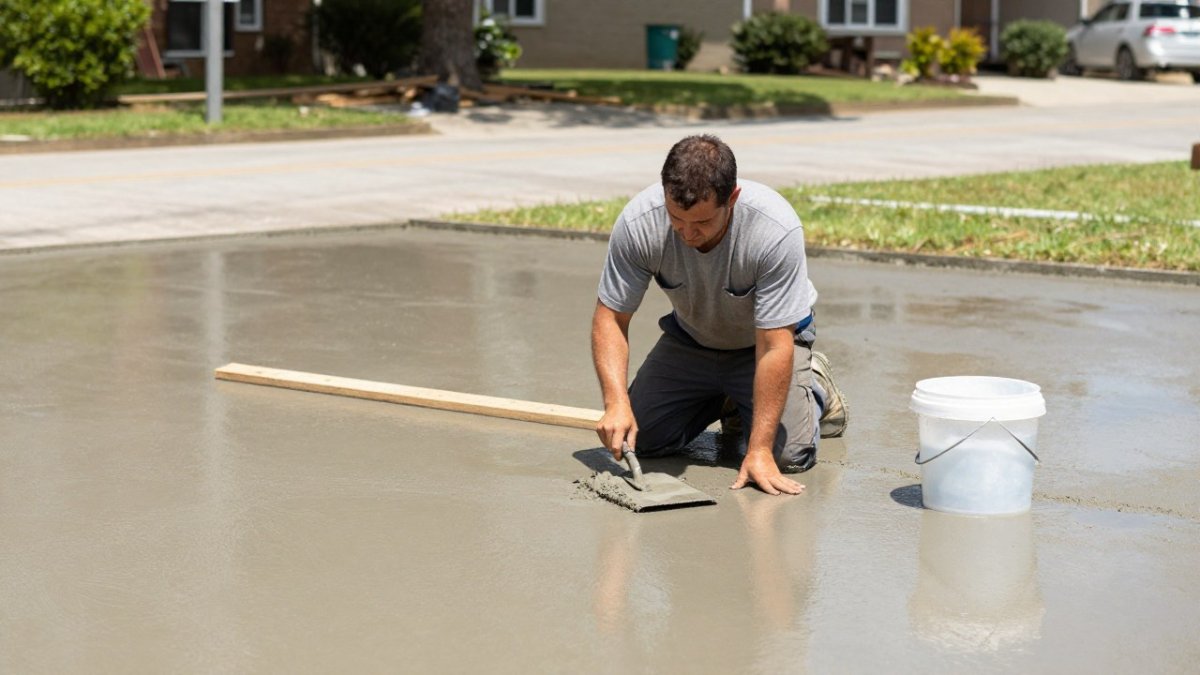
Last Updated: November 15, 2026
Quick Summary
To prevent concrete cracks in Louisiana, plan for heat, humidity and clay soil together. Prepare a stable, well-drained, compacted subgrade, use a controlled mix, cut control joints soon after finishing, and keep the surface moist and covered while it cures. Cracks cannot be eliminated completely, but these steps keep them controlled and small.
- Remove topsoil and organic material, and compact the base in thin layers.
- Let wet or soft clay subgrade dry and firm up before pouring.
- Ask for a mix with a controlled water-cement ratio and avoid adding water on site.
- Cut control joints soon after finishing, spaced about two to three times the slab thickness in feet.
- Apply curing compound or plastic covering right after finishing, and keep the slab moist and protected for several days.
Table of Contents
- Why Concrete Cracks in Louisiana’s Heat, Humidity and Clay Soil
- Prepare the Subgrade and Clay Soil Before You Pour
- Mix, Place and Control Joints to Limit Shrinkage
- How to Stop Concrete Cracking When Drying
- How to Stop Concrete Cracking in Hot Weather
- Acceptable Cracks in Concrete Slab and When to Act
- Choosing a Concrete Crack Sealer and Booking a Site Assessment
- Frequently Asked Questions
Why Concrete Cracks in Louisiana’s Heat, Humidity and Clay Soil
Concrete cracks in Louisiana for a simple reason: the climate fights the slab from every direction. Heat speeds up drying, humidity slows it down in unpredictable ways, and the clay soil underneath shifts with every rain.
Concrete shrinks as it cures and loses water. If the surface dries faster than the interior, stress builds up and the slab splits. Hot afternoons and wind make this worse.
Many local crews now treat cracking as a planning problem, not bad luck. The Louisiana Transportation Research Center’s 2026 project capsule reports that longitudinal cracks are showing up in concrete pavements in unexpected places, and that jointing practices are part of the investigation.
At CTi of Acadiana, LLC, we treat each slab as a site-specific job.
Prepare the Subgrade and Clay Soil Before You Pour
Most cracks start below the slab, not in it. Clay soil is the main culprit in this region. It holds water, swells when wet, and shrinks when dry, and a slab poured on unprepared clay has little chance of staying flat. The goal of subgrade preparation is to give the slab a stable, well-drained base that does not move seasonally.
Assess the soil before you build
A homeowner-friendly soil check starts with observation. Look for standing water after rain, soft spots, and areas where the ground has settled or cracked. Dig a small test hole to see the soil profile: dark topsoil, clay, and fill layers behave differently. If the site has been filled, ask what was used and how it was compacted. If you see deep cracks in the soil, significant settlement, or water that does not drain, it is worth consulting a geotechnical engineer or a qualified contractor before pouring.
Prepare the subgrade in layers
- Remove topsoil, roots, and organic material; these decompose and leave voids.
- Check for standing water or soft spots after rain and allow the subgrade to dry and firm up before proceeding.
- Compact the base in layers rather than all at once; thin lifts compact more uniformly than a single deep lift.
- Add a gravel or crushed-stone base where drainage is poor, and make sure the base is graded so water can escape.
- Slope the surface away from the slab to shed water, and plan downspouts and grading before the forms go in.
Good drainage matters as much as compaction. Water that pools under or beside a slab softens the clay and invites settlement. Think about where water will go during a heavy rain, not just on a dry day.
Project-specific considerations
Different slabs see different loads and exposure, so the subgrade plan should match the project.
Watch out: pouring on wet or loose clay is one of the costliest mistakes. Let the subgrade dry and firm up first, even if it delays the schedule, and never use fill to level a soft spot without compacting it properly.
The table below summarises the main subgrade steps covered in this section, so you can check each one before the pour.
| Step | What to do | Note |
|---|---|---|
| Remove organic material | Strip topsoil, roots and organic matter | These decompose and leave voids |
| Check for water | Look for standing water or soft spots after rain | Let the subgrade dry and firm up first |
| Compact in layers | Compact the base in thin lifts | Thin lifts compact more uniformly |
| Add gravel base | Use crushed stone where drainage is poor | Make sure the base is graded for drainage |
| Slope the surface | Grade the surface away from the slab | Plan downspouts and grading before forms go in |
| Avoid loose fill | Compact any fill used to level soft spots | Never leave uncompacted fill under the slab |
Mix, Place and Control Joints to Limit Shrinkage
Concrete cracks when it shrinks more than it can handle. The mix design controls how much it shrinks.
Placement matters too.
Control joints are your best tool for steering cracks. Cut them into the slab so the concrete breaks along a straight, planned line rather than at random.
Reinforcement helps too, but it works differently than most people expect. Wire mesh or rebar does not stop cracks from forming.
How to Stop Concrete Cracking When Drying
Drying is where many slabs go wrong. The top surface loses moisture faster than the inside, and that difference causes plastic shrinkage cracks, often within hours of pouring. The fix is simple but needs attention:
- Keep the surface moist from the first finishing pass until curing is complete.
- Apply a curing compound or cover the slab with plastic sheeting right after finishing.
- Mist the surface lightly if evaporation looks fast, but never flood it.
- Keep foot traffic and vehicles off the slab for as long as the mix requires.
- Remove forms and cure for the full recommended period before loading the slab.
Shade and wind play a big role. If the concrete is drying fast, use windbreaks or misting to slow evaporation. Covering the slab protects it while it sets.
How to Stop Concrete Cracking in Hot Weather
Hot weather is the hardest condition for concrete in this region, and an afternoon pour can start cracking before the finishers leave the site. The problem is not just temperature; it is the rate at which moisture leaves the surface (Plastic Shrinkage). When the surface dries faster than the interior, plastic shrinkage cracks form within hours. The fix is a time-based plan that starts before the truck arrives and continues for days after finishing.
Plan the pour around the weather, not the calendar
Hot-weather pours are often scheduled for early morning, ideally finishing before midday. If an afternoon pour is unavoidable, plan for shade, windbreaks, and extra curing materials on site before the first truck arrives. Avoid pouring during high wind or when the forecast shows a rapid drop in humidity, since both accelerate surface drying.
Pre-pour steps that buy you time
- Cool the subgrade and forms with water before placement, but let standing water drain away so the mix is not placed on a wet, soft base.
- Ask the supplier whether a retarder is appropriate for the mix and the day’s conditions; a retarder slows setting and gives finishers more time, but it must be used according to the mix design.
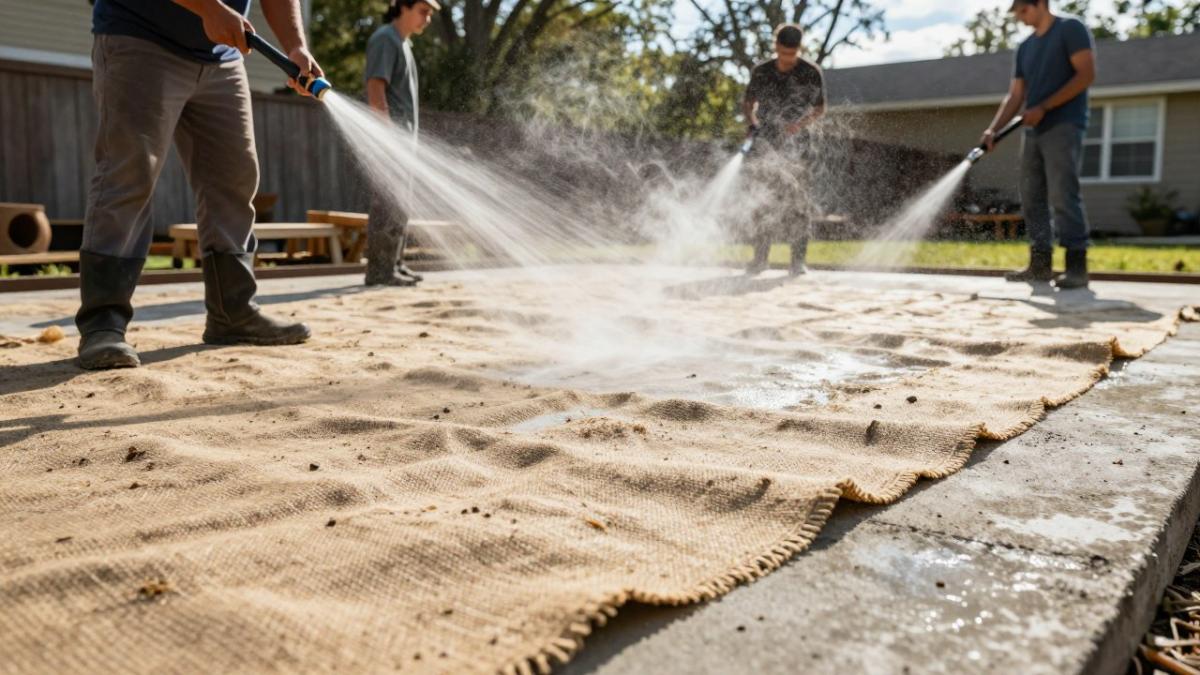
- Have curing materials on site before the pour: plastic sheeting, curing compound, damp burlap, or a combination that suits the slab.
- Set up windbreaks if the slab is exposed, and plan shade for the surface if the pour extends into sunny hours.
- Confirm that the finishers know the covering plan and who is responsible for starting it immediately after finishing.
A time-based curing plan after placement
The first 24 hours matter most. A practical sequence looks like this:
- Immediately after finishing: apply curing compound or cover the slab with plastic sheeting. Do not wait for the concrete to set; the surface begins losing moisture right away.
- First few hours: monitor the surface. If it looks dry or evaporation is fast, mist lightly with water, but never flood the slab. Keep the cover in place and check that wind is not lifting it.
- First day: keep the slab covered and damp. If using burlap, keep it wet; if using plastic, ensure it is sealed at the edges so moisture does not escape.
- Days 2 through 7: maintain moisture according to the mix and the project. Most residential slabs benefit from continued curing for several days, and the supplier or contractor should confirm the recommended period for the specific mix.
- Before loading: remove forms and allow the slab to cure for the full recommended period before foot traffic or vehicles. Early loading is a common cause of cracks that appear weeks later.
Pulling the cover back too early on a hot day can dry the surface in patches. Keep the cover on until the slab has gained enough strength.
Seasonal timing and weather planning
Heat and humidity do not behave the same way all year. In the hotter months, the risk is rapid surface drying and early setting; in cooler months, the risk shifts to slow strength gain and rain damage. A practical approach is to treat the pour as a weather-dependent event: check the forecast for the next 24 to 48 hours, not just the pour day, and have a rain plan that includes covering the slab and protecting the subgrade.
What to do if the surface starts drying too fast
If the surface is drying faster than expected, act immediately. Mist lightly, apply curing compound, or cover the slab, and slow the evaporation with shade or windbreaks. Do not try to re-trowel a surface that has already begun to set; that can draw more water to the top and weaken it. The goal is to keep the surface moist and protected until the concrete has enough strength to handle the conditions on its own.
Acceptable Cracks in Concrete Slab and When to Act
Not every crack is a problem. Hairline cracks, roughly the width of a thin line, are common in concrete and often cosmetic. Control joints doing their job will also show a crack at a planned line. Those are normal.
Act sooner when you see:
- Cracks wider than a few millimeters or that grow over time
- Uneven edges where one side of a crack has dropped
- Cracks that run in unexpected directions, not along joints
- Water seeping through or pooling beside the slab
- Gaps forming between the slab and a wall or walkway
A widening crack or a raised edge usually means movement underneath, often in the soil. At that point a visual check is not enough.
Choosing a Concrete Crack Sealer and Booking a Site Assessment
Once a crack is stable, sealing it can help keep water out.
Pricing for sealing and repair depends on the crack type, slab size and access.
If you are unsure whether a crack needs a fix or a professional look, book a free site assessment with CTi of Acadiana, LLC.
BUTTON: Schedule Your Free Estimate
CARD_TITLE: Is your slab cracking?
CARD_TEXT: CTi of Acadiana, LLC inspects, measures and estimates concrete repairs across Acadiana.
Frequently Asked Questions
Is there any way to keep concrete from cracking?
Concrete cannot be made completely crack-proof, but cracking can be controlled. Guidance from the National Ready Mixed Concrete Association, as summarized by a Lake Charles contractor, says cracks cannot be prevented entirely, only controlled. Proper control joint spacing, adequate slab thickness, a low water-cement ratio, careful subgrade preparation, and steady curing all reduce how often and how wide cracks open. Reinforcement helps control crack width but does not stop cracks from forming.
How do you prevent concrete from cracking in hot weather?
Hot weather speeds surface drying and causes plastic shrinkage, which is one of the most common reasons concrete cracks in Louisiana. Pour early in the morning or in the evening, keep the mix as cool as practical, dampen the subgrade before placing, and start curing immediately after finishing. Keep the surface moist with wet coverings or curing compound for several days so it does not dry out too quickly.
Are hairline cracks in concrete normal?
Hairline cracks are common in concrete and often reflect surface shrinkage rather than structural failure. Cracks that stay narrow and do not widen or displace the slab edges are generally considered acceptable for many slabs. Cracks that grow, let water in, or show uneven settlement deserve a closer look, since they can point to soil or drainage problems that need attention.
How can you tell whether a concrete crack needs repair?
Watch for cracks that widen over time, have one edge higher than the other, let water pool or seep through, or appear alongside settling, sinking, or new cracks elsewhere. These signs can indicate subgrade movement, clay soil shifting with moisture, or poor drainage. A site visit helps determine whether a crack is cosmetic or needs sealing, structural repair, or drainage correction. CTi of Acadiana, LLC offers on-site visual inspections and written estimates; visit the website for current scheduling and quotes.

No responses yet