


Quick Summary
The best pool deck alternatives to a Conkreteworkz quote depend on your slab’s condition, but resurfacing with a concrete overlay is often the lower-cost starting point. According to Zion Outdoors (2026), resurfacing typically costs 30% to 50% less than demolishing and pouring new concrete, and overlays can last 10 to 15 years or more with maintenance.
- Resurfacing typically costs 30% to 50% less than demolishing and pouring new concrete, per Zion Outdoors (2026).
- Concrete overlays can last 10 to 15 years or more with proper maintenance.
- Overlays suit sound slabs, while pavers suit slabs needing a rebuild or redesign.
- Porcelain pavers are named the top pool decking option for 2026 by Mineral Tiles (2026).
- Get a written, itemized estimate after an on-site inspection before work begins.
Table of Contents
- Why Homeowners Look for a Conkreteworkz Alternative for Pool Decks
- Pool Deck Resurfacing Cost: What Budget to Expect
- Concrete Overlay vs Pavers for Pools: Side-by-Side Comparison
- Best Pool Deck Materials for Heat Resistance
- Matching the Material to Your Existing Slab Condition
- Slip Resistance, Maintenance, and Long-Term Ownership Costs
- Choosing Your Next Step: Getting a Written Estimate for Your Pool Deck
- Frequently Asked Questions
Why Homeowners Look for a Conkreteworkz Alternative for Pool Decks
Many homeowners start searching for a conkreteworkz alternative for pool decks, or pool deck alternatives in general, after a first quote feels too high or a previous coating began to peel. The search is rarely about one bad experience. It usually comes down to cost, durability, slip safety and how the surface will feel in the Louisiana heat.
Owners often want a finish that looks finished, holds up through wet seasons and stays safe underfoot. They also want a price they can plan around before work starts.
Resurfacing is often the first option worth weighing. According to Zion Outdoors (2026), resurfacing typically costs 30% to 50% less than demolishing and pouring new concrete. Zion Outdoors 2026 pool deck cost comparison For a deck in reasonable shape, that gap can decide the whole project.
Here is what this guide covers: the budget range to expect, how overlays compare with pavers, which materials handle heat best, and how the condition of your existing slab changes the answer. We also address long-term ownership costs and what to ask before you sign anything.
Pool Deck Resurfacing Cost: What Budget to Expect
Pool deck resurfacing cost depends on deck size, the condition of the existing slab, and the finish you choose. Exact pricing varies by project, so the most reliable number comes from a written estimate after an on-site inspection.
Pricing depends on deck size, slab condition, prep work and finish selection, so the most reliable number comes from a written estimate after an on-site inspection.
Resurfacing is usually the lower-cost path compared with replacement. Zion Outdoors (2026) reports that concrete overlays can last 10 to 15 years or more with proper maintenance. Zion Outdoors 2026 overlay lifespan guidance That lifespan matters when you compare a one-time resurfacing bill against tearing out and pouring new concrete.
Several factors move the number up or down:
- Deck area: Larger decks cost more in material and labor, but the per-square-foot price often drops as area grows because setup and mobilization are spread across more square footage.
- Surface prep: Cracks, settling, or old coatings must be addressed first. Removing a failed coating can add meaningful labor before any new finish goes down.
- Finish choice: Decorative or textured finishes cost more than basic coatings. Stamping, staining, and multi-layer systems add material and skilled labor.
- Repairs: Crack injection, patching, and spall repair are priced separately from the finish. A slab with several active cracks will quote higher than a sound one.
- Access and disruption: Tight spaces, pool equipment in the way, and rushed schedules add labor.
- Drainage: Resetting drains, adding channel drains, or correcting slope so water moves away from the pool shell can add cost but prevents bigger problems later.
For a clear picture, ask for a written estimate that itemizes prep, repairs, materials, and finish. Get it before the estimator leaves the property. At CTi of Acadiana, LLC, that is how we handle custom estimates, so you know the price before work begins. You can see current pricing details on our pool decks page.
Watch out: a quote that is dramatically lower than the others may mean prep, crack repair, or a quality topcoat has been left out, and those line items can affect how long the finish lasts.
Concrete Overlay vs Pavers for Pools: Side-by-Side Comparison
Concrete overlays and pavers solve different problems. An overlay resurfaces an existing slab. Pavers replace the surface with individual units set over a prepared base.
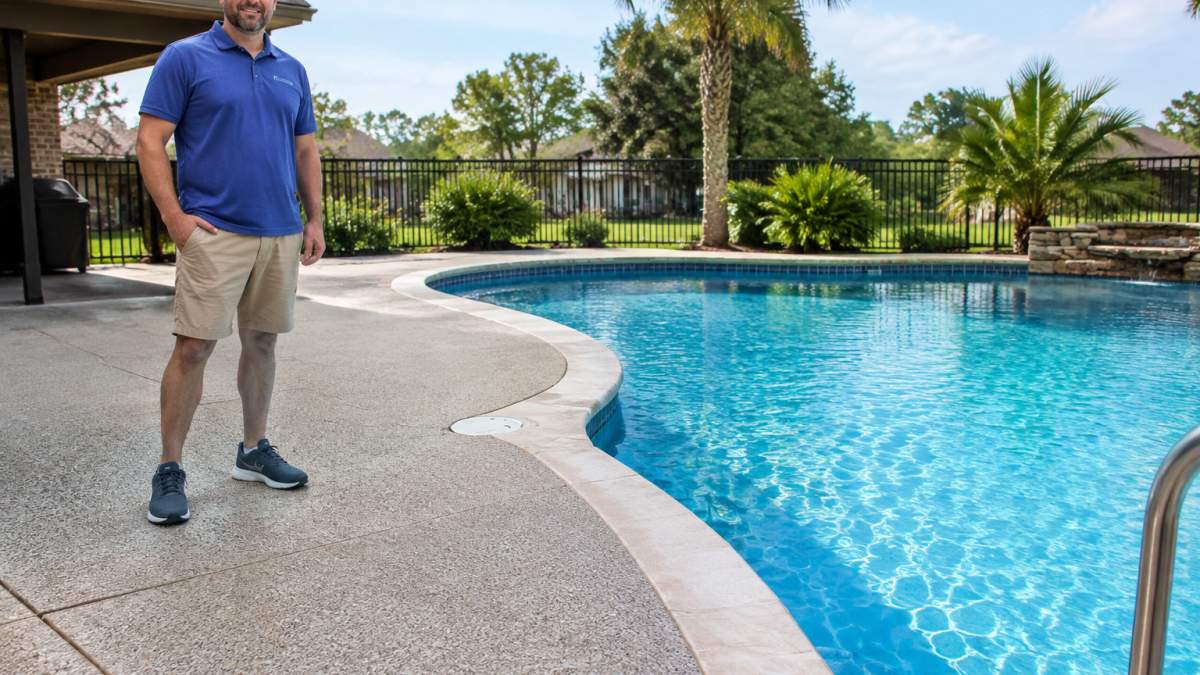
Overlays are often a faster and less disruptive option. They work well when the underlying slab is sound and you want a fresh look without tearing anything out. The tradeoff is that an overlay cannot fix a structural problem underneath.
Pavers offer more design flexibility and can be easier to repair one unit at a time. They also involve more labor and more joints, which means more places for weeds and debris to collect. Pavers are often a better fit when the base needs rebuilding anyway.
Here is a quick comparison:
| Factor | Concrete Overlay | Pavers |
|---|---|---|
| Best for | Sound existing slab | Slabs needing rebuild or redesign |
| Disruption | Lower | Higher |
| Design options | Stamped or textured finishes | Wide range of shapes and patterns |
| Repairs | Patch and recoat | Replace individual units |
| Typical lifespan | 10 to 15+ years with maintenance (Zion Outdoors, 2026) | Varies with base and installation |
If you are still deciding, our 7 Old World Concrete Design Alternatives Compared article looks at more options from the same group of finishes.
Best Pool Deck Materials for Heat Resistance
Heat matters on a pool deck. Surface temperature can climb quickly in Louisiana summers, and a dark or hard finish can become uncomfortable to walk on barefoot.
Porcelain pavers rank highly in current rankings. Mineral Tiles (2026) names porcelain pavers its top pool decking option for 2026, based on slip resistance and material performance. Mineral Tiles 2026 pool decking rankings Ask your installer how any surface handles direct sun before committing.
Carvestone is another material worth knowing. Allied Outdoor Solutions ranks it highly for pool decks because of its heat resistance and durability compared with standard concrete. Allied Outdoor Solutions pool concrete deck rankings Light colors and textured finishes generally stay cooler than smooth, dark surfaces.
Traditional poured concrete remains the most economical decking option, according to Mid State Pools (2026). Mid State Pools 2026 deck material cost analysis Its heat performance depends heavily on color and finish, so the coating or texture you choose matters as much as the base material.
Matching the Material to Your Existing Slab Condition
The right material depends on what is under the surface today. A sound slab and a cracked slab call for very different approaches. The most useful way to decide is to sort your slab into one of four conditions, because each one points to a different scope of work, and sometimes to a different contractor.
Sound slabs with surface wear
When the slab is structurally sound but the finish is faded, pitted, or worn, an overlay is often the right move. Prep work focuses on cleaning, profiling, and repairing hairline cracks so the new layer bonds properly. This is where a resurfacing cost advantage is most real: you avoid demolition and keep the existing foundation. A textured overlay or a paver overlay set on a prepared base are both reasonable here.
Cracked but stable slabs
Hairline and shrinkage cracks that are not widening or offsetting are usually cosmetic. They can be routed, filled, and bridged with a flexible patching material before the finish goes down. The key question is whether the crack is moving. If it has widened since last season or one side sits higher than the other, treat it as a structural signal rather than a cosmetic one.
Uneven or settling slabs
Settling and uneven slabs need more attention. Groundworks has used polyurethane foam injection to lift and level settling concrete pool decks, restoring uneven surfaces without full demolition. Groundworks polyurethane foam concrete lifting case study Lifting can address the surface height, but it does not replace a proper inspection of the soil beneath. A Basement Authority of WV (2026) analysis notes that overlays may not address underlying soil instability as effectively as full replacement. Basement Authority of WV 2026 concrete overlay limitations If the slab is moving, resolve that first, otherwise the new finish inherits the same problem.
Spalling, scaling, or previously coated slabs
A slab that is flaking, scaling, or covered in a failed coating is the most common reason a first quote comes back high. Old coatings must be removed or mechanically profiled before a new overlay will bond, and spalled areas need patching. This is also where a paver system can be the better answer: pavers sit on a prepared base and do not depend on the old surface bonding at all.
A simple decision rule helps: if the slab is sound, an overlay is usually the lowest-cost path; if it is uneven, lifting plus an overlay can work; if it is spalling or coated, expect extra prep or consider pavers; if it is moving or has structural cracks, get the cause diagnosed before choosing any finish. Ask your contractor which of these four conditions your slab falls into, and make them show you the evidence on site.
Slip Resistance, Maintenance, and Long-Term Ownership Costs
Slip resistance is a safety issue, not a cosmetic one. Ask for the texture and the coating’s slip rating, and check how the surface feels when wet. Our Hallmark System is designed to be easy to care for and slip safe.
Ownership cost goes beyond the install price. Consider how often the surface needs cleaning, sealing or recoating, and how easily a small repair can be made. A slightly higher upfront cost often pays off if it means fewer repairs over the next decade.
For a broader look at surface safety, our article on 7 Reasons Concrete Pool Decks Get Slippery explains what drives slipperiness and how to address it. Our guide to which concrete coating is most slip resistant compares coatings side by side.
Choosing Your Next Step: Getting a Written Estimate for Your Pool Deck
The most useful next step is a site visit. A proper inspection checks the slab condition, measures the deck and identifies any cracks, settling or drainage issues. That is the information needed to recommend an overlay, pavers or a lifting repair.
At CTi of Acadiana, LLC, we offer free custom estimates with an on-site visual inspection and detailed measurements. You receive a comprehensive written estimate by the end of the business day, and you see the price before the estimator leaves the property. Portfolio projects are available for review on an iPad.
Ready to move forward? Schedule your free estimate and we will walk through your deck, your options and your budget.
Last Updated: November 12, 2026
BUTTON: Get Your Free Pool Deck Estimate
CARD_TITLE: Is your pool deck worth resurfacing?
CARD_TEXT: CTi of Acadiana, LLC offers free on-site inspections and written estimates by the end of the business day.
Frequently Asked Questions
What can you put around a pool instead of concrete?
Common options include concrete pavers, travertine and other natural stone, porcelain pavers, and decorative or stamped concrete. Each has different tradeoffs in slip resistance, heat under bare feet, and upkeep. Pavers can be installed over a prepared base, while overlays resurface a sound existing slab. Before choosing, have the existing concrete inspected for cracks, settling, and moisture, because that condition often decides which alternative is practical. A written, on-site estimate can show which option fits your budget and your slab.
What are the cheapest options for a pool deck?
For an existing sound concrete slab, resurfacing with a concrete overlay is often the lowest-cost route compared with full demolition and a new pour. Pavers and natural stone generally cost more than overlays. Pricing depends on square footage, slab condition, prep work, and finish selection, so compare written quotes rather than online averages.
Is it better to resurface or replace a damaged pool deck?
Resurfacing is usually the better choice when the slab is structurally sound and the damage is surface-level, such as worn finish, light cracking, or discoloration. Replacement makes more sense when the slab is heaving, sinking, or cracked through its full thickness. Resurfacing often costs less than demolition and a new pour, and an overlay can provide long-lasting results with proper maintenance. A site inspection is the only reliable way to tell which situation applies to your deck.
How do I know my written estimate will be the final price?
CTi of Acadiana, LLC provides a free on-site visual inspection and detailed measurements, then delivers a comprehensive written estimate by the end of the business day. The price is given before the estimator leaves the property, so you can review it against your budget. For current pricing and to schedule your free estimate, contact CTi of Acadiana, LLC through its website.

No responses yet