

Quick Summary
The best slip resistant concrete coatings depend on the surface: outdoor patios and pool decks need water-based or acrylic products with built-in texture, while garages and workshops need durable epoxy or polyurea systems with aggregate. Ratings should be confirmed with each manufacturer before purchase.
- Slip resistance is measured by the coefficient of friction (COF).
- Pool decks suit water-based epoxy designed for barefoot wet use.
- Garages and workshops need durability and chemical resistance from epoxy or polyurea.
- Surface preparation often accounts for more of the invoice than the coating itself.
- Recoat before the base coating is breached to avoid moisture damage.
Table of Contents
- Why Slip Resistance Matters on Concrete Surfaces
- How We Evaluated the Best Slip Resistant Concrete Coatings
- Quick Comparison: Top Slip Resistant Concrete Coatings
- Best Options for Patios, Pool Decks and Outdoor Spaces
- Best Options for Garages, Workshops and Commercial Floors
- How Much Does Professional Concrete Coating Cost?
- Non-Slip Additives for Concrete Sealer and Coating Systems
- How to Maintain Slip-Resistant Concrete Over Time
- Frequently Asked Questions
Last Updated: November 4, 2026
Slipping on a wet patio or a greasy garage floor is one of the most common and avoidable home and workplace injuries. Choosing the best slip resistant concrete coatings for your space comes down to how the coating is made, what texture it has, and how it holds up to your local weather. At CTi of Acadiana, LLC, we help property owners across the Acadiana area compare these options before they commit. Below, we explain what makes a coating slip resistant, how we evaluated the options, and which products fit different surfaces.
Why Slip Resistance Matters on Concrete Surfaces
Slip resistance is a surface’s ability to keep feet from sliding, and it is measured by the coefficient of friction (COF).
Concrete is naturally smooth once it is sealed or painted, and that smoothness is the problem. Water, oil, and fluid spills turn a sealed slab into a hazard within seconds. Textured additives solve the problem by creating micro-grip on the surface. Learn why concrete coatings fail outdoors and how to prevent it.
How We Evaluated the Best Slip Resistant Concrete Coatings
Ratings and performance claims should be confirmed with each manufacturer before purchase.
Quick Comparison: Top Slip Resistant Concrete Coatings
| Product | Type | Best For | Slip Resistance | Starting Price |
|---|---|---|---|---|
| Garon STOP-SLIP HD | Industrial epoxy | Commercial workshops | High-profile texture | $417.00 |
| Penntek Evolution | Polyurea | Basements, high-traffic garages | Works with anti-slip aggregate | Contact for pricing |
| Exterior Coatings Anti-Slip Epoxy | Water-based epoxy | Pool decks, patios | Designed for barefoot wet use | Contact for pricing |
| INSL-X Anti-Slip Coating Paint | Acrylic | Outdoor patios | Built-in non-skid texture | Contact for pricing |
| Slip Doctors Alpha Grip | Non-slip paint | DIY patios, walkways | Advanced non-slip formula | Contact for pricing |
Best Options for Patios, Pool Decks and Outdoor Spaces
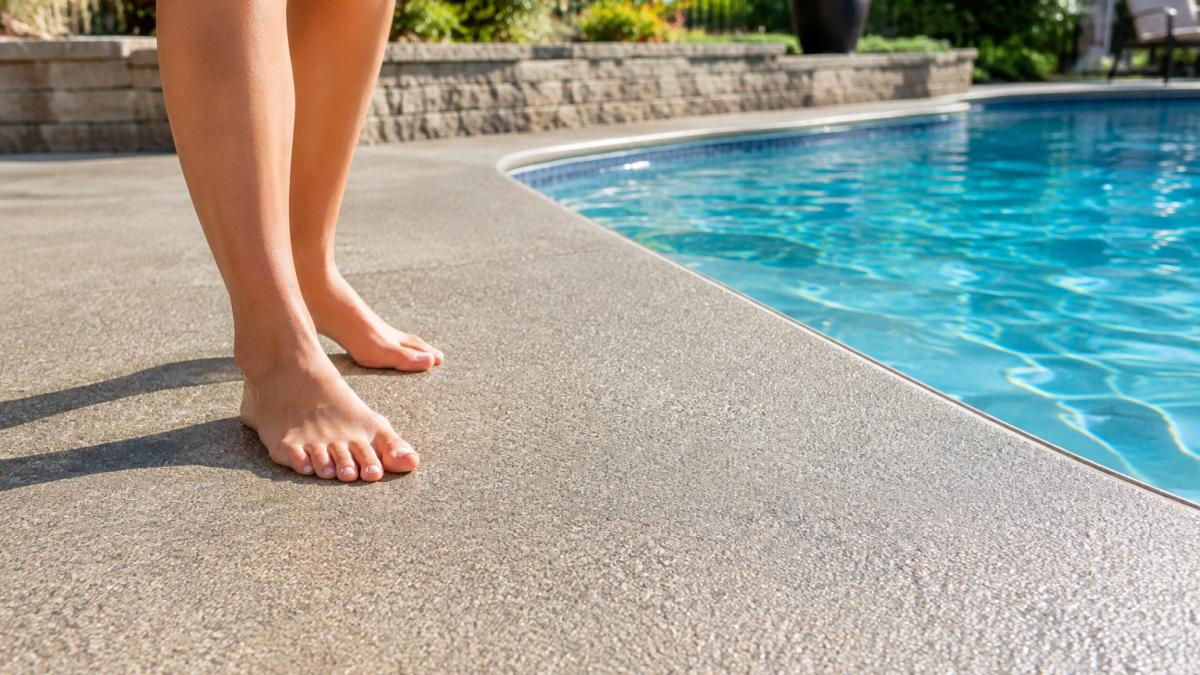
Outdoor surfaces face sun, rain, and pool water, so UV resistance and wet-grip matter most. Explore our pool deck coating options for wet-area grip.
Best Options for Garages, Workshops and Commercial Floors
Indoor workshops and garages deal with oil, heavy loads, and chemicals. Here, durability and chemical resistance take priority. See our garage floor coating services for these spaces.
How Much Does Professional Concrete Coating Cost?
Coating cost on concrete is driven by four variables: square footage, surface condition, coating system, and prep work. Because most slip-resistant products are sold as “contact for pricing,” the honest way to budget is to separate material cost from installed cost and understand what moves each one.
Material cost. A two-part epoxy or polyurea system with broadcast aggregate runs higher because you are buying resin, hardener, primer, and grit separately.
Installed cost. Professional installation adds surface preparation, which is often a significant part of the total cost. Grinding or shot-blasting a garage floor, repairing cracks and spalls, and applying a moisture-tolerant primer can account for more of the invoice than the coating itself. A common pattern is that a straightforward garage slab costs far less per square foot than a pool deck with failing previous coating, tight edges, and drainage details. Decorative flake or stamped overlays add cost on top of the slip-resistant base.
What changes the number most:
- Square footage. Larger jobs lower the per-square-foot price because mobilization and prep setup are spread across more area.
- Surface condition. Existing coatings that must be stripped, oil-soaked concrete, and spalled or cracked slabs all add labor.
- Moisture. A slab with high moisture vapor emission needs a vapor-barrier primer or the coating will blister, which adds material and time.
- Access and edges. Pool decks, stairs, and walkways with many cut lines and borders take longer per square foot than an open rectangle.
- System choice. A single-component paint is the budget option; a broadcast-aggregate epoxy or polyurea is the durable option; a full commercial system with primer, basecoat, broadcast, and topcoat is the top of the range.
DIY versus professional. A homeowner applying an anti-slip paint or a roll-on epoxy kit saves the labor line but owns the prep, and prep is where most failures start. If the slab has old sealer, efflorescence, or oil stains, the money saved on labor is often spent redoing the job. Professional installation makes sense when the surface needs mechanical preparation, when the coating must hold vehicle traffic, or when a warranty matters.
At CTi of Acadiana, LLC, we offer free custom estimates. You can request a free coating estimate for your surface. We inspect your surface on site, take detailed measurements, and provide a comprehensive written estimate by the end of the business day. For current pricing or to schedule your free estimate, visit our website at https://Www.ctiofacadiana.com. You can also book your free estimate appointment directly online.
Non-Slip Additives for Concrete Sealer and Coating Systems
Many sealers and paints do not provide slip resistance on their own.
Mix the additive according to the manufacturer’s directions and apply it while the coating is still wet so it bonds properly.
How to Maintain Slip-Resistant Concrete Over Time
Slip-resistant coatings do not fail all at once. The texture that provides grip is a physical profile, and that profile wears down where feet and tires travel most. Maintenance is really two jobs: keeping the surface clean so the profile stays exposed, and knowing when the profile has worn enough to recoat.
Why grip fades. Broadcast aggregate and built-in texture sit at or just below the surface. Abrasion from foot traffic, grit tracked in from outside, and vehicle tires gradually polish the high points. Oil, soap scum, pollen, and algae fill the valleys between aggregate particles and create a slick film even when the texture is intact. That is why a floor can feel slippery while still looking textured, the profile is there but it is clogged or polished smooth.
Cleaning that preserves texture. Sweep or blow off debris regularly, and rinse oil, grease, and chemical spills promptly before they soak in. Use a pH-neutral cleaner or a manufacturer-approved concrete cleaner rather than harsh degreasers, which can soften or strip the coating and leave a residue that is itself slippery. A stiff-bristle brush or a low-pressure washer works on textured surfaces; high-pressure washing can blast aggregate loose at the edges and should be kept away from seams and transitions.
Inspection method. Pick the high-traffic lanes, the path from the door to the car, the pool steps, the walkway centerline, and compare them to a protected corner. Run a hand or a rubber-soled shoe across both. If the traveled area feels noticeably smoother or glossier than the protected area, the profile has worn. A simple field check is to wet the surface and walk it in the same shoes you normally wear; if the wet feel has changed since installation, that is your signal.
Recoating decision. When grip fades, you have two options. A maintenance coat, a fresh topcoat with a light broadcast of aggregate, restores texture over a sound existing coating and is the cheaper path. A full recoat is needed when the coating is delaminating, cracked, or worn through to bare concrete. Recoat before the base coating is breached; once water reaches the concrete, freeze-thaw and moisture vapor problems begin and the repair grows.
Schedule. Check the surface at least once a year, and sooner in high-traffic, wet, or freeze-thaw areas. Pool decks and commercial entries often need a mid-season inspection. Keep a record of the product and aggregate used so a maintenance coat matches the original system.
Frequently Asked Questions
What is the best non-slip coating for concrete?
The best choice depends on where the surface is. For outdoor patios and pool decks, acrylic and water-based epoxy coatings with built-in texture or grit are commonly used because they handle sun, water and bare feet. For garages and commercial workshops, two-part epoxy or polyaspartic systems with grit additives provide higher abrasion resistance and heavier traffic tolerance. Ask for the product’s slip-resistance rating and surface preparation requirements before deciding.
How do slip-resistant additives work in concrete coatings?
Slip-resistant additives are typically fine aggregate, grit or textured media mixed into the final coat. The particles raise the surface’s friction so that shoes and bare feet grip rather than glide, even when the surface is wet. Additives are generally blended into the topcoat or broadcast into a wet layer. Standard topcoats can make a floor more slippery, which is why adding non-skid media to the final coat is often recommended.
How often should outdoor concrete coatings be reapplied?
Reapplication timing depends on the product, traffic, sun exposure and how the surface is maintained. Outdoor coatings exposed to UV, standing water and foot traffic generally wear sooner than garage or indoor floors. Inspect the surface each year for thinning texture, peeling edges or dull grip. Regular cleaning and resealing as recommended by the manufacturer extend service life. For a specific schedule matched to your slab and exposure, request an on-site inspection.
Choosing the right coating comes down to matching the product to your surface and traffic. CTi of Acadiana, LLC provides free custom estimates, on-site inspections, and a Hallmark System that is easy to care for and slip safe. Schedule Your Free Estimate today and receive a price before the estimator leaves your property.

No responses yet